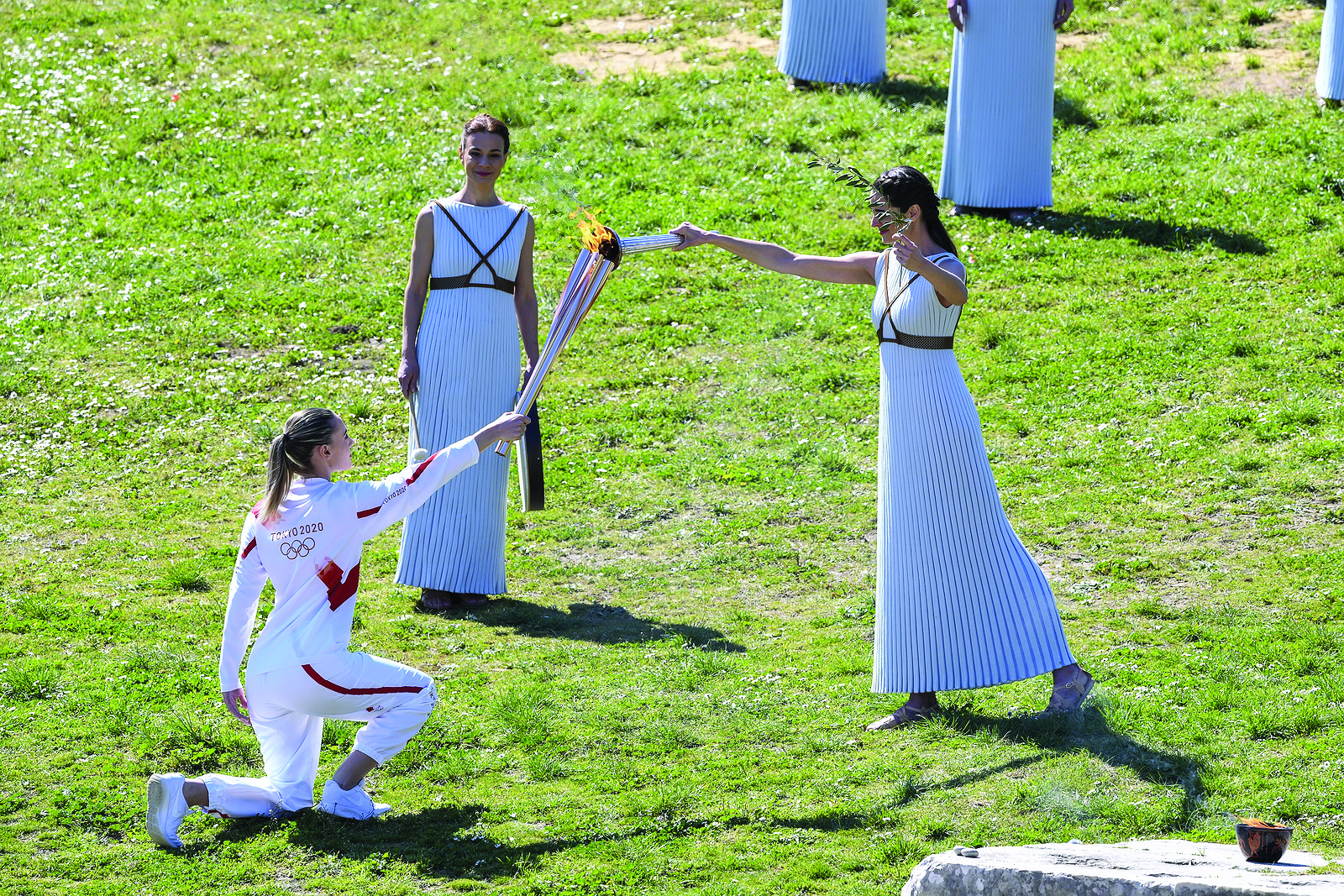
While there is no shortage of symbols associated with the Olympic Games, likely none captures the spirit of peaceful competition more than the Olympic flame. Highlighting the ideals of “Citius, Altius, Fortius” (Faster, Higher, Stronger), the flame links the modern Games with the ancient Games. And as has been the case with all Winter Games since Innsbruck 1964 (and the Summer Games since Berlin 1936), the Olympic flame burning in Milan and Cortina this month was first lit in front of the ruins of the Temple of Hera in Olympia, Greece. That’s where the Olympic flame is ignited by focusing sunlight with a parabolic mirror. This traditional method is the only way the flame can be lit, as it preserves the purity of the sun’s rays. Once ignited, the flame is placed in an urn and transported to the ancient stadium in Athens, where the high priestess in charge of the ceremony passes it to the first runner in the Olympic Torch Relay. This process takes place several months before the Games open to ensure the flame can be relayed to the host city in time.
The first ancient Olympic Games are believed to have been held in Olympia in 776 BC. A fire burned throughout the ancient Games, linked to the myth of Prometheus (famous for stealing fire from the gods to give to mortals). The ancient games were eventually banned by the Romans in 393 AD. However, when the Olympics were revived in France in 1896, fire wasn’t part of the ceremonies. It wasn’t until the 1928 Amsterdam Games that the flame returned, and the torch relay began at the 1936 Berlin Games. For the Milan-Cortina Games this month, the flame was originally lit on November 26 last year and subsequently traveled 63 days across Italy, passing through 60 cities and covering 12,000 kilometers across all 110 provinces of the country, before arriving at the opening ceremony on February 6. It was carried by 10,001 torchbearers, each playing an important role: announcing the Olympic Games and conveying a message of peace and friendship to the communities along its route.