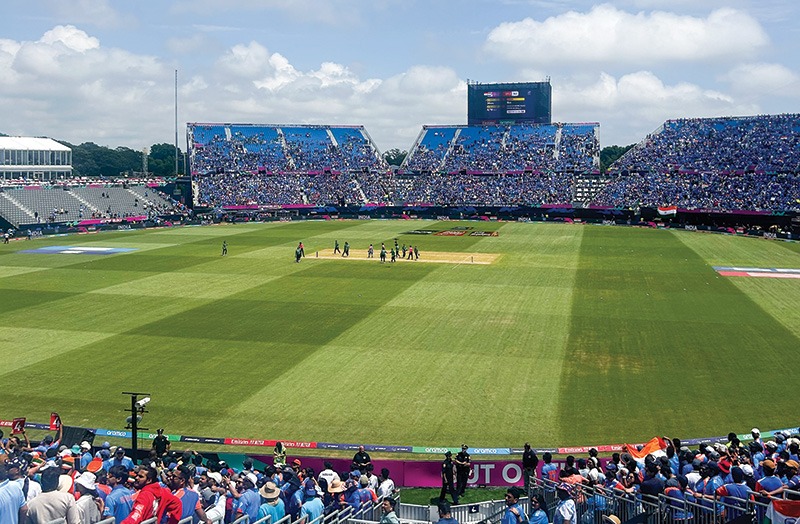
T20 Cricket World, which took place for the first time in the U.S. in June 2024. Courtesy NCanny
The phrase “here today, gone tomorrow” has appeared in countless song lyrics over the years, but few would immediately associate those words with sports venues. However, for a growing number of event organizers, that expression fits perfectly.
Temporary sports structures—from inflatable domes to fully built 34,000-seat stadiums—are increasingly giving planners new options for hosting competitions at every level. Designed to be constructed, used, and then dismantled, these facilities are redefining what a sports venue can look like.
While the concept may feel modern, it is anything but new. The Romans erected temporary wooden amphitheaters for gladiator contests as early as the second century BC. What has changed is the scale, sophistication, and strategic role these structures now play in global sport.
For planners navigating rising construction costs, sustainability pressures, and tight timelines, temporary facilities are no longer a novelty. They are a viable option and an important factor to consider in operations, provided you keep the following points in mind.
The pros and cons
Temporary sports structures are flexible, customized facilities that can be assembled within days, weeks, or months and remain in place only as long as needed. Their appeal begins with cost.
These facilities can be 50 to 70 percent less expensive than traditional brick-and-mortar buildings. Lightweight framing systems and modular components reduce both construction time and labor demands. Because they are not intended for decades of continuous use, long-term maintenance costs are typically lower as well.
Flexibility is another major advantage. Temporary venues can be tailored to specific sports or events, then removed once the competition concludes. That adaptability gives planners more control over venue size, configuration, and timing.
Seasonal adaptability also plays a role. Inflatable domes, commonly known as “bubbles,” are frequently installed during colder months and removed in the spring. Tennis, soccer, and basketball programs in colder climates have relied on these structures for years to extend playing seasons without investing in permanent indoor complexes. But temporary does not mean without risk.
Durability can be a concern, particularly in extreme weather conditions. While modern engineering has significantly improved reliability, temporary structures may not offer the same resilience as permanent facilities. Repeated assembly and disassembly can also cause material fatigue over time.
Amenities may also be more limited. Advanced HVAC systems, permanent locker rooms, and premium hospitality features sometimes give way to more streamlined solutions. In certain cases, planners must balance cost savings against creature comforts.
The key is understanding the event’s needs—and matching the structure to the mission.

A 34,000-seat stadium in 100 days
One of the most visible recent examples of a large-scale temporary venue came in 2024, when the ICC Men’s T20 Cricket World Cup made its debut appearance in the United States.
Eisenhower Park in Nassau County, New York, became home to a purpose-built stadium that seated 34,000 spectators. The structure was constructed in approximately 100 days and dismantled soon after the nine-day tournament concluded. While the stadium itself was removed, the outfield remained in place.
Across eight days of matches, approximately 165,000 spectators attended the event, generating a significant economic impact for the region. Darcy Belyea, commissioner of Parks, Recreation and Museums for Nassau County, was on the ground overseeing the operation.
“The temporary stadium and hospitality venues all held up very well throughout,” Belyea says. She also noted that “this was the first event of its kind in the United States,” and that California Governor Gavin Newsom and representatives from the upcoming Los Angeles Olympic organizing committee attended to observe the tournament.
That said, the New York experiment was not universally well-received. Some players and commentators publicly noted that the drop-in pitches produced inconsistent bounce and unusually low scores early in the tournament, prompting the International Cricket Council to acknowledge that the pitches “have not played as consistently as we would have all wanted.” A drop-in pitch in cricket is a pre-prepared playing surface created off-site and transported to a stadium for use during matches. This approach enables multipurpose venues, such as those used for soccer or football, to host cricket without requiring a permanent cricket square to be constructed on the grounds.
Still, despite some criticism, the scale of the undertaking was substantial. Coordinating crowd flow for tens of thousands of fans each day required detailed planning, especially since many construction and infrastructure components were sourced from across the country. Deadlines were tight, and managing overlapping priorities and logistics was a challenge.
However, with the assistance of deputy commissioner Timothy Messner and a large team, Nassau County successfully executed an event that demonstrated that temporary structures could perform at the highest level of international sport—even as stakeholder feedback highlighted the challenges of building at this scale.
For planners, the takeaway was clear: a venue does not need to be permanent to be world-class, but careful stakeholder engagement and operational planning remain essential.
A stadium inside a stadium
Temporary construction is not limited to one-off global tournaments. The Miami Open tennis tournament provides another high-profile example.
Each year, a 13,800-seat tennis stadium is constructed inside Hard Rock Stadium, home of the NFL’s Miami Dolphins. The tennis court is built directly atop the football field—creating what is essentially a stadium within a stadium.
The transformation delivers a unique viewing experience and allows the tournament to use existing infrastructure while tailoring the environment to elite professional tennis.
James Blake, tournament director of the Miami Open, described the process during a Tennis Channel interview as “a challenge, but a rewarding one.” He praised the support of Miami Dolphins owner Steve Ross and tournament personnel in building what he called a top-flight facility within a compressed timeframe and limited resources.
The project underscores both the complexity and opportunity of temporary builds. With careful coordination and strong partnerships, existing venues can be reimagined to serve entirely different sports.
Seasonal solutions: the rise of the bubble
While international tournaments capture headlines, temporary structures are perhaps most visible at the amateur and recreational levels.
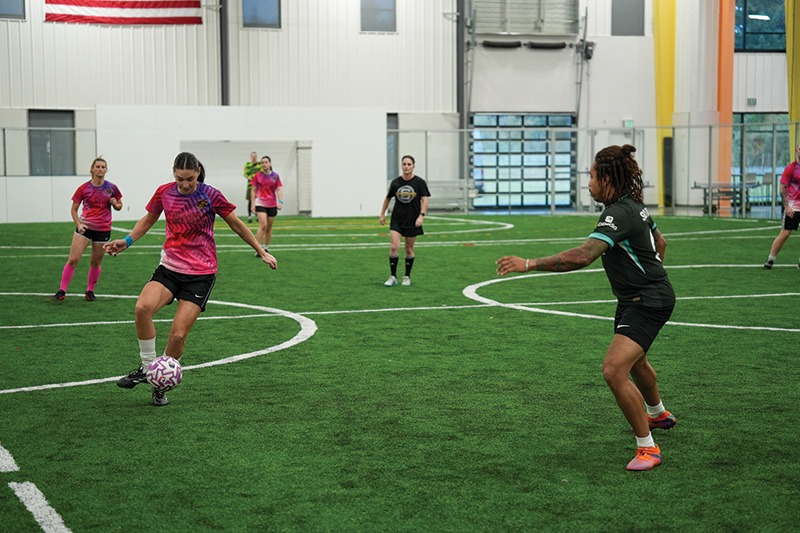
Inflatable domes, or “bubbles,” have long been used in tennis and are increasingly common in sports such as soccer and pickleball. Facilities in colder climates frequently install bubbles during the winter months and remove them in the spring.
The approach extends playing seasons without the cost of permanent indoor construction.
Manny Iqbal, a former prominent tennis teaching professional who organized numerous events inside bubble facilities, recalls earlier reliability challenges.
“Every once in a while, when I was working inside the bubble, something would go wrong with the structure, and it needed to be temporarily taken down,” Iqbal says.
Those occurrences, he noted, are now rare as materials and engineering have improved significantly. For local event planners, bubbles provide a practical, scalable solution, though, as with any temporary facility, weather resilience and material durability remain considerations.
The Olympic influence
If temporary structures once carried a perception of being secondary, the Olympic Games have helped reshape that narrative. Past Games have drawn criticism for constructing permanent venues that later fell into disuse—costly reminders of short-term needs driving long-term consequences.
Paris 2024 marked a deliberate shift. Organizers emphasized combining temporary structures with existing venues to reduce new construction. Georgina Grenon, director of environmental excellence for the Paris 2024 Olympics, framed the strategy succinctly: “The single most important decision we have made is not to build.”
By limiting permanent construction, Paris reduced costs and addressed sustainability concerns.
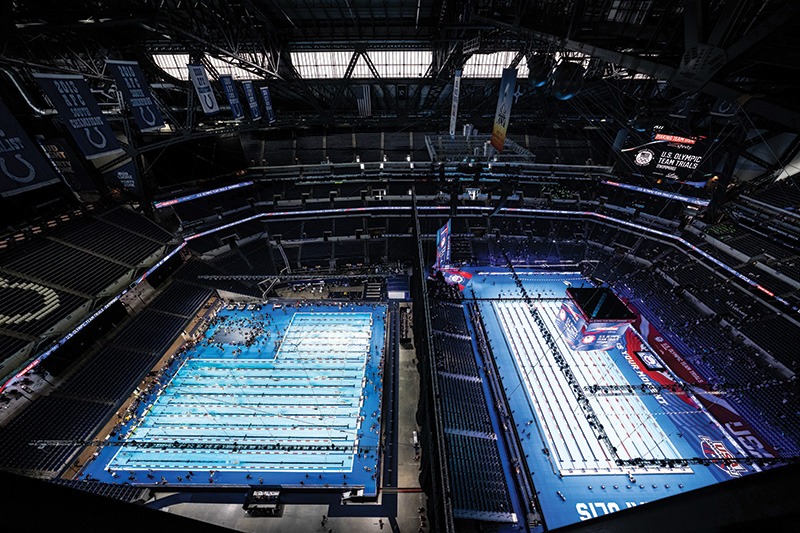
Temporary design also played a role in the 2024 U.S. Olympic Swimming Trials in Indianapolis, where a large aquatic arena was erected inside Lucas Oil Stadium. Temporary seating and lighting transformed the NFL venue into a swimming showcase, and served as a preview of similar strategies planned for the Los Angeles 2028 Games.
Los Angeles 2028 intends to rely heavily on temporary installations across more than 40 venues, along with housing units throughout the region. While still representing a significant investment, these structures are expected to cost
far less than constructing new permanent facilities.
The Milano Cortina 2026 Winter Olympic Games also continued the trend. Pop-up speed-skating rinks, modular athlete villages, and other temporary facilities were constructed specifically for the Games and later disassembled or repurposed.
For event planners worldwide, the message is unmistakable: temporary is no longer a compromise—it can be a real benefit.
What planners should consider
Temporary structures are not a universal solution. They demand detailed logistical planning, clear timelines, and reliable partners. Weather contingencies must be addressed. Material fatigue and durability should be evaluated carefully, and amenity expectations must align with event goals. However, when matched to the right purpose, temporary facilities offer compelling advantages, including lower upfront costs, reduced long-term maintenance, customizable design, seasonal flexibility, and sustainability benefits.
As global events from cricket to tennis to the Olympic Games continue to embrace temporary builds, the stigma once associated with “non-permanent” venues is fading. These structures are engineered to deliver professional experiences and then disappear, leaving no costly footprints.
A permanent place in event strategy
Temporary sports structures may be here today and gone tomorrow. But their strategic role in event planning appears firmly established.
From neighborhood pickleball tournaments under inflatable domes to 34,000-seat international cricket stadiums constructed in just 100 days, temporary venues are proving their value across every level of competition. For planners facing financial constraints, sustainability pressures, and evolving audience expectations, the question is no longer whether temporary structures are viable. It comes down to how and when to use them.