Survey results show that the sports event calendar may be holding up, but the economics of staging events are getting tighter.

More than anyone, planners know the challenges of putting on a successful sports event: finding the right venue, controlling costs, securing sponsors, and delivering a great experience for athletes, teams, and fans. And with expenses rising and staffing challenges persisting, the job isn’t getting any easier. Yet demand remains strong, with planners organizing more events and registration holding steady or increasing for most. Our 2026 Sports Tourism Industry Outlook Study explores the pressures shaping the industry, from rising operating costs and limited venue availability to sponsorship hurdles and volunteer shortages. Here’s what planners are telling us about the state of the industry, and what it means for the tournaments and events they’re planning in the year ahead.
The overview
Respondents to our 2026 Sports Tourism Industry Outlook Study host an average of 24 tournaments and events a year, with 57.7% organizing at least 21 and 44.4% hosting more than 30. Their events also draw sizable fields, averaging 313 participants per tournament or event. More than half of respondents (56.8%) report events with over 300 participants, while one in four report events with over 500 participants.
That activity spans the country, with respondents planning tournaments and events in all 50 states over the next 12 months. Florida was the most frequently cited state, followed by Kansas, New York, and Washington.
But a busy calendar and steady demand don’t necessarily translate into an easier operating environment. While registration numbers are holding steady or increasing for most respondents, the cost of delivering events continues to climb. Among those answering the operating cost question, 64.5% said their costs were higher than the previous year. Meanwhile, 89.4% of those answering the registration question reported that registrations were about the same or had increased.
The contrast offers a snapshot of a familiar planning challenge: demand may be holding up, but organizers
still have to find ways to pay for the people, places, and services that make events possible.
This study gathered responses from people involved in sports events, including rights holders, event planners, and sports commissions. The results point to several connected pain points: rising operating costs, competition for suitable facilities, difficulty securing sponsors, and a shortage of volunteers. They also show how planners are responding, from raising registration fees to negotiating better vendor terms and using technology to support event operations.
The price of putting on a tournament
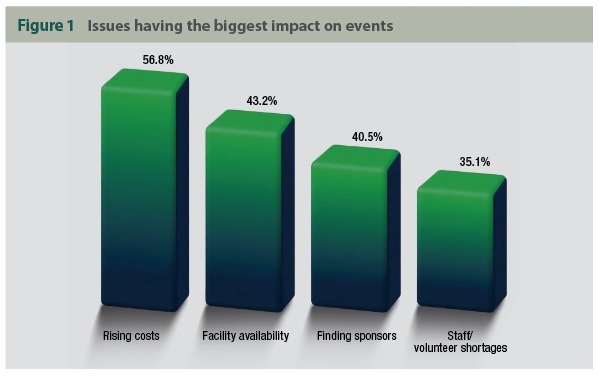
Among respondents who identified issues affecting their events over the past 12 months, rising costs were the most frequently cited challenge, at 56.8%. Facility availability ranked at 43.2%, followed by finding sponsors at 40.5%, and staffing or volunteer shortages at 35.1% (see figure 1).
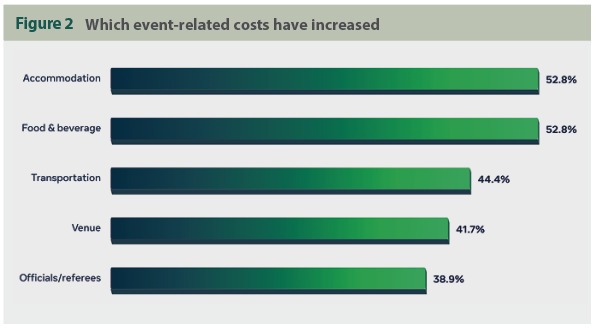
The expense categories help explain the pressure. Accommodation and food and beverage were each identified by 52.8% of respondents answering the question about rising costs (see figure 2). Transportation was cited by 44.4%, venue expenses by 41.7%, and officials or referees by 38.9%. Those costs can touch different parts of an event budget, from lodging for traveling teams to the practical expenses of operating a venue and paying qualified officials.
Planners are taking a range of steps to respond. Just over half of those answering the question said they were increasing registration fees (51.7%), while 48.3% were making greater efforts to secure sponsors. About one-third (34.5%) said they were negotiating better vendor contracts or terms. Smaller shares reported changing venues or using more volunteers (17.2% each).
Some are also trimming spending. Food and beverage were the most frequently selected areas for cost cuts, at 37%, followed by marketing (22%), entertainment (18.5%), and venue selection (14.8%). Nearly three in 10 respondents to that question said they had not cut costs.
These responses illustrate the balancing act organizers face: reducing expenses can help protect a budget, but decisions about food, marketing, awards, or entertainment may also affect the experience they want to deliver. The survey does not measure the effects of individual choices, but the mix of strategies suggests planners are looking across both revenue and expense lines for ways to keep events viable.
Finding room to grow
The cost squeeze is only part of the challenge. Suitable facilities can be a limiting factor in whether events grow, and they also play a major role in where organizers choose to host them.
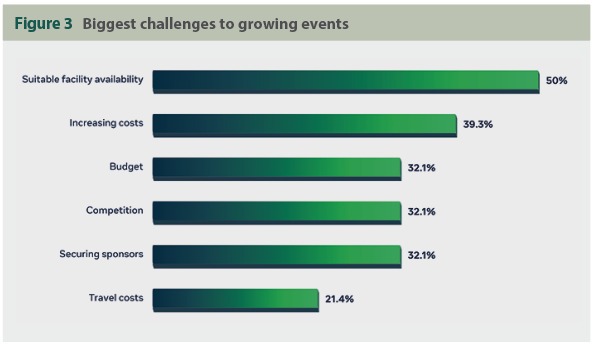
Half of the respondents answering the question about growth challenges selected the availability of suitable facilities. Increasing costs came next at 39.3%, while budgets, competition from other organizations, and securing sponsors each drew 32.1%. Travel costs were cited by 21.4% (see Figure 3).
When asked what most effects destination and venue selection, 66.7% identified venue availability and 55.6% pointed to venue cost. Accommodation costs (40.7%), local or CVB support (37%) and accommodation availability (33.3%) also featured prominently. In other words, a destination may be attractive, but planners still need the right facility at a workable price, along with lodging and local support.
Repeat business appears important in this equation. Among those who answered the question, 88.5% said they host events at repeat destinations or venues. Location was the most frequently selected reason for returning (67.9%), followed by participant feedback (53.6%), venue suitability, and relationships with destination or venue staff (50% each). Destination experiences and local attractions were also a factor for 46.4%, while cost was cited by 42.9%.
For destinations and venues, the findings suggest that retaining an event is about more than a one-time bid. Reliable facilities, good working relationships, and a positive participant experience all matter to organizers deciding whether to return.
People and partnerships matter
Even when a facility is available, events need people to run them and partners to help fund them. The survey identifies both as pressure points. Volunteers were by far the most frequently selected hard-to-fill staffing role, cited by 63.3% of respondents to that question. Officials and referees followed at 23.3%, while medical personnel were cited by 13.3%. Volunteer shortages also appeared among the broader challenges affecting events, selected by 35.1% of respondents answering that question.
Sponsorship is another concern. Of those who answered the question about whether they solicit sponsors, 73.1% said they do. Among respondents who answered the follow-up question about securing sponsors, 52.6% said it had become harder over the past 12 months, while 36.8% said it was about the same. One respondent said sponsorship was easier, and one said it was much harder.
To counter rising expenses, 48.3% of respondents to the relevant question said they were increasing their efforts to secure sponsors. The results do not explain why sponsorship has become more difficult or which approaches are most successful, but they underline the importance of partnerships in the event planning mix.
For organizers, the practical challenge is to make the event attractive not only to participants, but also to volunteers, officials, sponsors, and local partners whose support helps make it possible.
Evolving use of marketing and technology
Planners are also using familiar marketing channels and event technology to support their work. Email was the most commonly used marketing tactic, selected by 80.6% of respondents answering that question. Instagram followed at 71% and Facebook at 67.7%. Word-of-mouth was used by 54.8%, while YouTube and partnerships with other organizations were each selected by 41.9%.
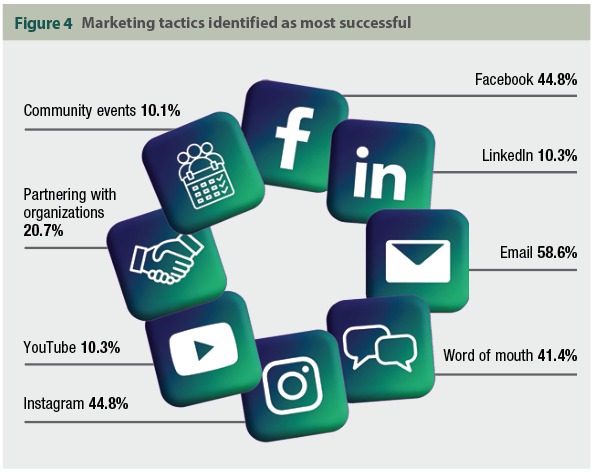
Asked which tactics were most successful, 58.6% selected email. Facebook and Instagram tied at 44.8%, followed by word-of-mouth at 41.4% (see figure 4). The pattern suggests that planners are relying on channels they already use and, in many cases, consider effective.
Among technologies identified as having a positive impact, live streaming led at 44%, followed by registration software at 32% and scheduling software at 24%. Mobile apps were selected by 20% of respondents, while CRM or marketing software and AI tools each drew 16%.
AI use remains limited among those answering that question: 20% said they use AI tools, while 80% said they do not. Among the small group reporting AI use, common applications included administrative tasks, graphic design, presentations, and content creation.
The bottom line
Taken together, the survey’s findings show planners working across several fronts: managing expenses, securing the right facilities, finding people and sponsors, and choosing tools to support their work. Registrations may be holding steady for many respondents, but sustaining an event still requires close attention to the details behind the competition. For organizers looking to grow, the task is not simply to attract more participants. It is to build an event model that can keep pace with the costs and resources required to deliver it.